
Window Tint Brands Explained: What’s the Difference and Which Is Best for You?

If you're researching window tint for your home or building, you've probably run into names like LLumar, 3M, Solar Gard, Hüper Optik, Madico, and XPEL. All six are established film manufacturers, but that doesn't mean their products are interchangeable, or that one brand beats the rest across the board.
The real differences come down to film technology: how much heat gets rejected, how much visible light stays, how reflective the glass looks, and what the film is actually built to do. Some films chase maximum heat reduction. Others stay light and barely noticeable. Some use ceramic technology, some are highly reflective, and some use multilayer construction to manage solar energy without darkening the glass.
So instead of asking which brand is best, the more useful question is which film is best for your windows.
What Actually Changes Between Brands
Every manufacturer uses different technology to manage the solar energy hitting your glass, and that technology drives three numbers worth knowing.
VLT (Visible Light Transmission) is how much visible light passes through the window. Higher VLT means a lighter-looking film. TSER (Total Solar Energy Rejected) measures the percentage of total solar energy the filmed glass rejects, a better gauge of overall performance than any single number. Visible reflectance tells you how mirror-like the finished glass will look.
You'll also see brands advertise infrared rejection. Don't confuse this with total heat rejection. Infrared is only one slice of the solar spectrum, which is why TSER tells a more complete story.
Understanding these three numbers matters more than picking a familiar name.
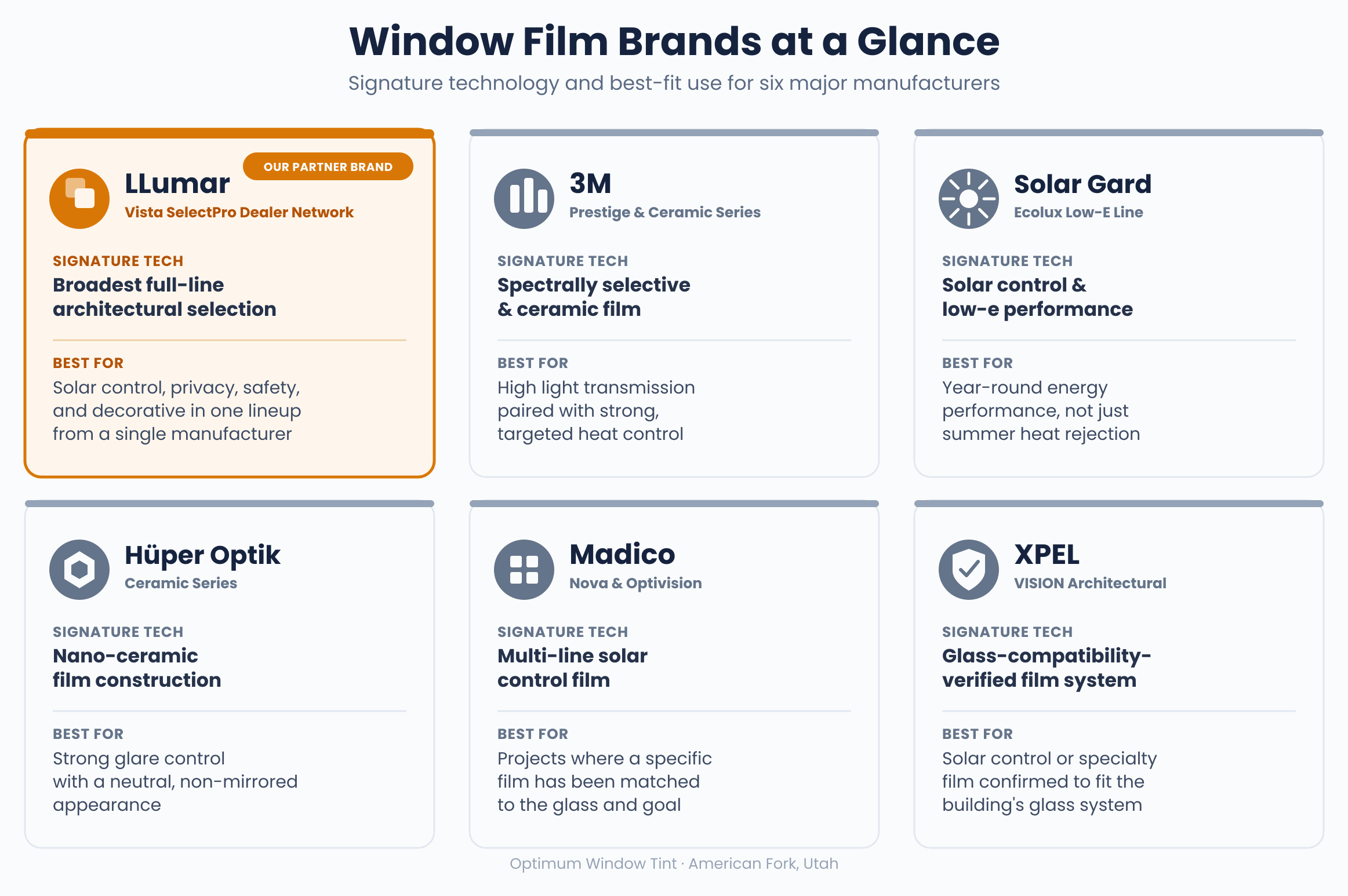
LLumar Window Film
LLumar carries one of the broadest architectural film lineups in the industry, covering both residential and commercial applications.
Its films target solar heat, glare, UV exposure, privacy, safety, security, decorative glass, and commercial performance, including options that keep views neutral for anyone who wants solar control without changing how their windows look.
That breadth is the real advantage of a manufacturer like LLumar: instead of forcing one film to do everything, an installer can match the film to the glass and the goal. A west-facing living room fighting afternoon heat needs something different than a room where the priority is protecting hardwood floors from UV. A commercial office trying to cut screen glare needs a different solution again.
We install LLumar's Vista Select lineup directly as a Vista SelectPro Dealer through Eastman, so this is a brand we work with on real jobs, not just spec sheets.
LLumar may be a strong option for: homeowners and businesses that want one manufacturer with a deep enough lineup to cover everything from subtle solar control to privacy, decorative, and safety film.
3M Window Film
3M has a long track record in the window film industry, and its architectural lineup includes the Prestige Series, spectrally selective film built to control solar energy while keeping visible light relatively high. 3M also makes ceramic architectural films that manage heat with ceramic particles rather than a dark or reflective look.
That matters because one of the biggest myths in window tint is that darker automatically means better heat rejection. Modern architectural film can target specific parts of the solar spectrum while letting plenty of visible light through, so homeowners who want to keep their natural light and views have more options than traditional dark tint offers.
3M also makes safety and security film, built to hold shattered glass together rather than manage solar heat.
3M may be a strong option for: anyone interested in established spectrally selective, ceramic, solar control, or safety film technology for residential or commercial glass.
Solar Gard Window Film
Solar Gard runs one of the more varied architectural lineups, with products for solar control, low-e performance, safety and security, decorative glass, bird protection, and anti-graffiti. Options range from reflective film to lower-reflectivity films built for more clarity.
Its Ecolux line is worth knowing about specifically. It's a low-e film designed for year-round energy performance, rejecting summer heat while also helping retain warmth in winter, which matters if energy efficiency across all four seasons is the priority rather than just beating the July heat.
Warranty coverage varies by product. Several residential lines carry limited lifetime warranties, while commercial terms depend on the film.
Solar Gard may be a strong option for: homeowners and commercial properties that want a wide range of solar, low-e, reflective, safety, or specialty film to choose from.
Hüper Optik Window Film
Hüper Optik is best known for ceramic architectural film. Its Ceramic Series spans darker films built for stronger glare reduction and daytime privacy down to very light options, including Ceramic 20, 30, 35, 40, and 70, plus the especially light Klar 85.
Ceramic technology appeals to homeowners who want strong solar control without the mirror-like look of some metallic films. That doesn't make it automatically better than every other technology, though. Spectrally selective, metallic, reflective, and hybrid films all have their place, and the right choice depends on matching the technology to the goal.
Hüper Optik may be a strong option for: anyone especially focused on ceramic film, a neutral appearance, glare control, and keeping as much natural light as possible.
Madico Window Film
Madico is another long-established manufacturer with residential and commercial solar control products, including its Nova and Optivision lines alongside reflective, safety and security, and decorative film.
As with the other manufacturers here, what matters isn't whether a window has "Madico tint," it's which specific film was used. Different products within the Madico lineup carry very different VLT, reflectivity, and heat-control numbers.
Madico may be a strong option for: residential and commercial projects where an installer has already identified a specific Madico film that fits the glass and the goal.
XPEL Architectural Window Film
Most people know XPEL from automotive tint and paint protection film, but the company also makes architectural film. Its VISION lineup covers solar control, security, decorative, bird-strike, and anti-graffiti applications, and XPEL publishes film-to-glass compatibility data for its products.
That last detail matters for every window film project, not just XPEL's: not every film belongs on every piece of glass. Window construction, existing coatings, pane configuration, sun exposure, and where the film goes all affect which products will actually work.
XPEL may be a strong option for: anyone looking for solar control or specialty film where an installer has confirmed the product fits the building's glass system.
Show Image
So Which Brand Is Actually Best?
For most homeowners, no single brand wins in every category.
Want as much natural light as possible? A lighter spectrally selective or ceramic film probably makes sense. Fighting a brutal west-facing room and don't mind extra darkness or reflectivity? A different solar control film might outperform it for your priorities. Glare is the real problem? Cutting more visible light might actually be the goal. Want daytime privacy? Reflectance and VLT move to the front of the list.
Commercial buildings work the same way. An office may care most about glare and employee comfort, while a storefront cares more about appearance, privacy, security, or keeping merchandise out of direct sun.
That's why comparing brands by name alone tends to be misleading.
What You Should Actually Compare
You don't need to become a window film expert before booking an install, but knowing a handful of specs makes the conversation with your installer a lot more useful.
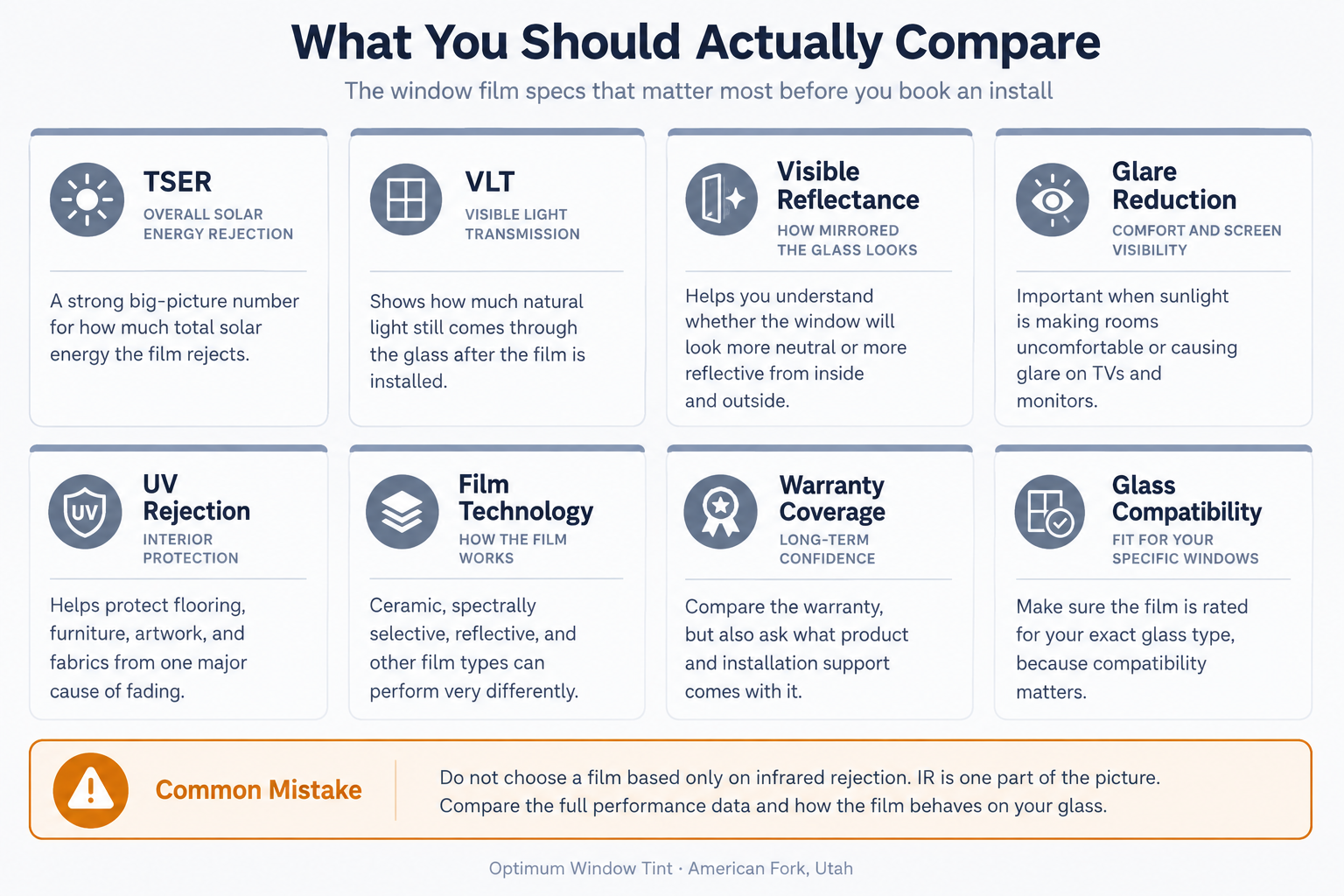
Ask about TSER for overall solar energy rejection, VLT for how much light stays, visible reflectance for how mirror-like the glass will look, glare reduction, UV rejection, the film technology itself, warranty coverage, and whether the film is rated for your specific glass.
One common mistake is chasing whichever film advertises the highest infrared rejection number. IR rejection is one piece of the picture, not the whole thing. Look at the full performance data and how the film actually behaves on your glass.
The Film Matters, But So Does the Installer
Even a great film is the wrong choice on incompatible glass or for the wrong reason. Glass type, pane configuration, existing coatings, window orientation, exterior shading, and sun exposure all factor into which film makes sense.
A good installer should be able to explain why they're recommending a specific film, not just that they carry a good brand.
At Optimum Window Tint, we match the film to what you're actually trying to fix, whether that's a scorching west-facing room, glare without losing the view, UV protection for your interior, daytime privacy, or better performance for a commercial building.
There's no shortage of good window tint brands. The right film is the one that fits your windows, your goals, and your budget, not just the name on the box.