
How Much Does Window Tinting Cost in Utah? A Straightforward Guide

If you have been thinking about tinting the windows on your home or business, one question probably comes up before all the others: what is this going to cost me? It is a fair question, and it is usually the hardest one to get a straight answer to. Search around and you will find price ranges so wide they are almost useless, quotes that seem to depend on the weather, and a whole lot of "it depends."
Here is the honest version. Window film pricing really does depend on a handful of specific factors, and once you understand what those are, the numbers stop feeling mysterious. This guide walks through what actually drives the price of professional window tinting in Utah, how installers build a quote, roughly where different projects tend to land, and why quality film is one of the better returns you can get on a home or commercial building.
We are not going to throw out a single hard price and pretend it applies to your project, because it would not. What we will do is give you enough understanding to read any quote you receive and know whether it makes sense.
Why There Is No Single Price for Window Tinting
Window film is not a product you buy off a shelf in a fixed size. It is a material that gets measured, cut, and installed to fit your exact glass, by hand, by a trained installer. That means the price is built from your specific situation rather than pulled from a set menu.
Think about it the way you would think about flooring or countertops. Nobody can tell you what new floors cost without knowing the square footage, the material you want, and the condition of what is already there. Window film works the same way. A small home office with two windows and a large storefront with a full glass facade are completely different jobs, even though both are "window tinting."
That is actually good news. It means you are not paying for a one-size-fits-all package. You are paying for exactly the glass you have and the performance you want, and nothing extra.
The Six Factors That Shape Your Quote
Every reputable quote comes down to some combination of the same core factors. When you understand these, you can look at any estimate and understand where the number is coming from.
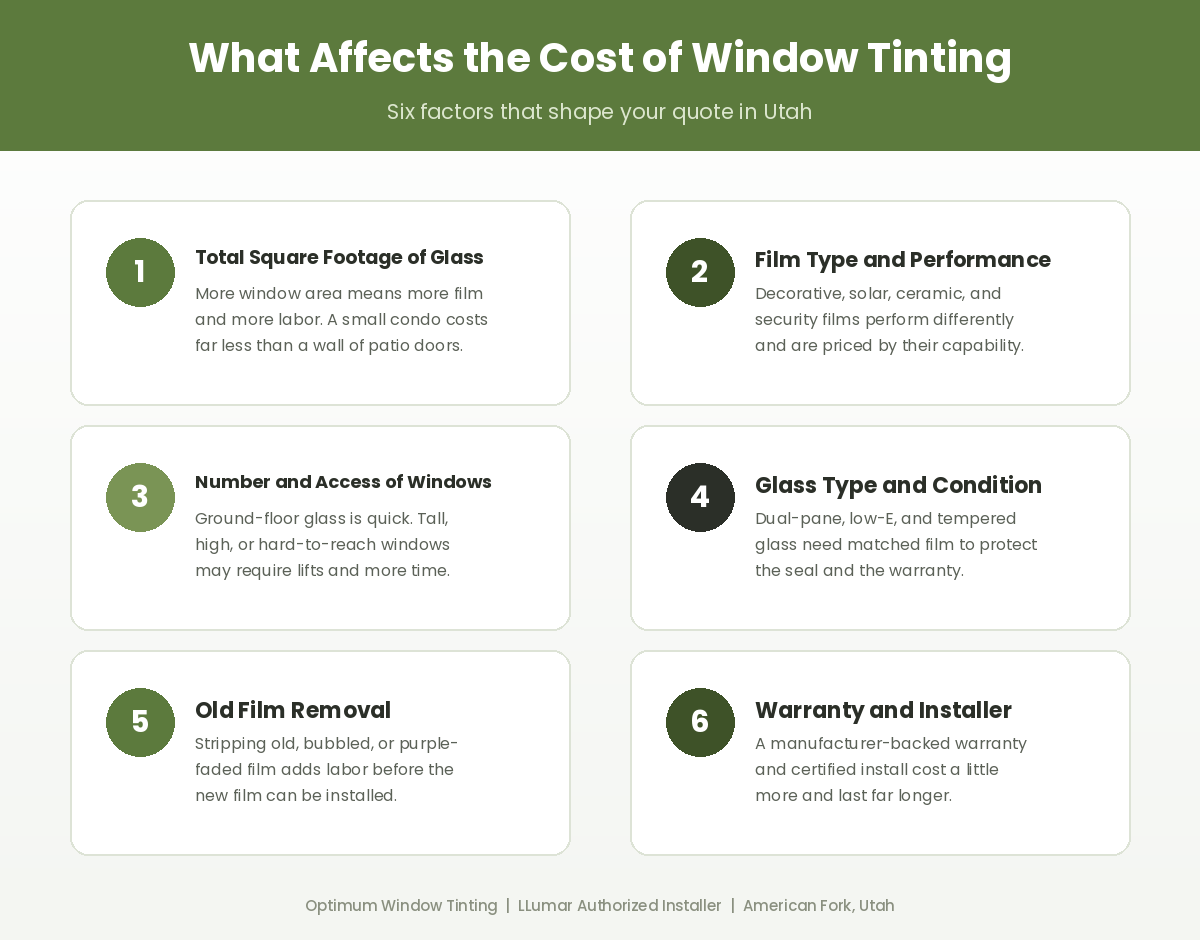
1. Total square footage of glass
This is the biggest single driver. More glass means more film and more labor, so a project is priced largely by how much window area needs to be covered. A condo with a few standard windows is a small job. A home with floor-to-ceiling windows and a wall of patio doors is a much larger one. Commercial buildings with extensive glass facades are larger still. Square footage is where most of your cost lives.
2. Film type and performance level
Not all window film does the same thing, and the performance you choose has a real effect on price. Basic solar films reduce heat and glare at an affordable entry point. Ceramic films deliver the strongest heat rejection while staying optically clear, which is why they sit at the premium end. Security films are built thick to hold shattered glass together, and decorative films add privacy or style. You are paying for what the film actually does, so matching the film to your goal keeps you from overspending or underbuying.
3. Number and accessibility of windows
Two projects with the same square footage can still price differently based on how the glass is laid out and how easy it is to reach. Ground-floor windows are quick to work on. Tall interior glass, high windows, stairwell landings, or anything that needs a ladder or lift takes more time and setup. Accessibility is a quieter factor, but it is a real one, especially in homes with vaulted spaces and in multi-story commercial buildings.
4. Glass type and condition
The glass itself matters. Modern homes often have dual-pane, low-emissivity, or tempered glass, and these need to be paired with film that is compatible with them. Using the right film protects the seal between panes and keeps the glass manufacturer's warranty intact. A good installer will always ask about your glass, and matching the film correctly is part of what you are paying a professional to get right. Cracking and breaking a window is a real concern if you don't correctly match your window film to the window.
5. Old film removal
If your windows already have film on them, especially old film that is bubbling, peeling, or turning purple, that has to come off before new film goes on. Removal is labor-intensive and adds to the project. It is not a hidden fee so much as a real step, and a quality installer will factor it in and explain it rather than surprise you with it later.
6. Warranty and installer quality
Finally, who does the work and what stands behind it affects the price. A certified installation backed by a manufacturer warranty costs a little more than a bargain job with no guarantee. That difference is not markup for its own sake. It is the reason the film performs as promised, looks clean with no bubbles or peeling, and keeps looking that way for years. This is the factor people most often regret cutting. That said, quality films like Llumar films have lifetime warranties (with a few small exceptions).
How Installers Actually Build a Quote
Once you know the factors, the quoting process itself is pretty logical. Here is roughly how a professional puts your number together.
First comes the assessment. A good installer either visits the property or gathers detailed information about your windows: how many, what size, what type of glass, what floor they are on, and whether any existing film needs removal. This is why the best quotes come after someone has actually looked at your specific glass rather than guessing over the phone.
Next is the film selection. Based on what you are trying to accomplish, whether that is knocking down summer heat, cutting glare on screens, adding privacy, protecting furnishings from fading, or improving safety, the installer recommends a film tier that fits the goal. This is the conversation that has the biggest effect on both performance and price, so it is worth being clear about what matters most to you.
Then the square footage is measured or estimated and multiplied against the chosen film. Labor is factored in based on the number of windows, their accessibility, and any removal work. The result is a project price, not a per-window sticker, because the whole job is what determines the cost.
The takeaway is simple. A quote that comes after a real look at your glass and a conversation about your goals is worth far more than a fast number pulled out of thin air. If an estimate feels suspiciously round and instant, it is probably missing information that will resurface later.
Ballpark Expectations: Where Projects Tend to Land
We promised not to invent exact prices, and we will keep that promise, because a made-up number helps nobody. What we can do is give you a sense of relative scale so you know roughly what kind of project you have.
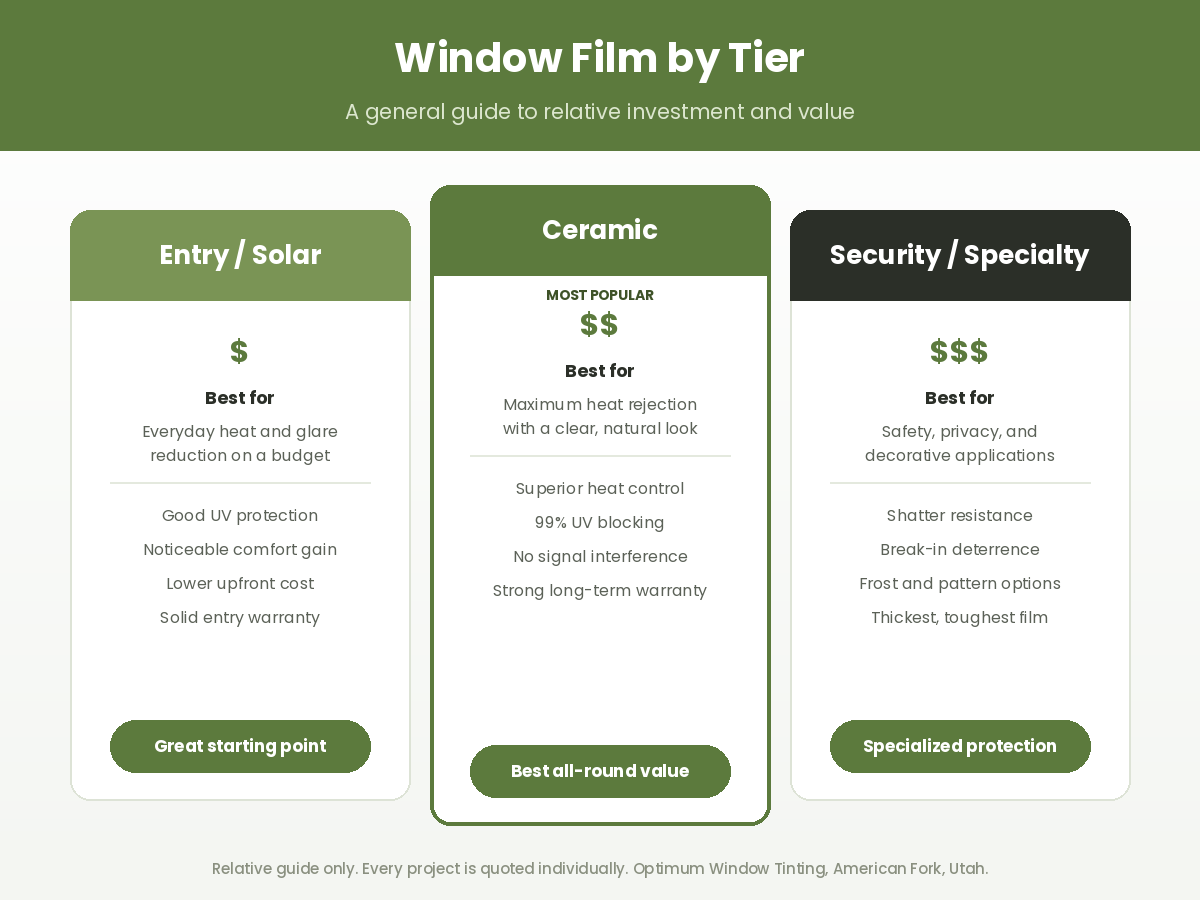
At the accessible end sit entry-level and solar films. These are the budget-friendly choice for homeowners who want meaningful heat and glare reduction without a large upfront investment. They block UV, improve comfort noticeably, and come with a solid warranty. For a lot of homes, this is a genuinely great starting point.
In the middle, and by far the most popular choice, are ceramic films. These cost more than entry-level film but deliver the best all-round value. You get superior heat rejection, blocking of 99 percent of UV rays, no interference with cell or Wi-Fi signals, and a long, strong warranty, all while keeping a clear and natural look. Most people who want their tint to perform and last land here, and over the life of the film the value is hard to beat.
At the premium end are security and specialty films. These are thicker, tougher, and built for specific jobs: holding glass together against break-ins, adding shatter resistance, or providing decorative privacy with frosted and patterned looks. They cost the most because they do the most specialized work.
Where your specific project falls depends on the six factors above. A small home with entry-level film is a modest investment. A large home or commercial building with premium ceramic across extensive glass is a bigger one. The honest answer to "what will mine cost" is that a proper quote is the only way to know, and getting one is quick and free.
Why Window Tinting Is Worth It
Cost is only half the equation. The other half is what you get back, and this is where window film quietly outperforms a lot of home and building upgrades.
Start with energy. A large share of unwanted heat comes in through glass, and quality film rejects a significant portion of it. That means less strain on your air conditioning through Utah's hot summers, more stable indoor temperatures, and lower cooling bills month after month. Unlike a lot of improvements, tint keeps paying you back every billing cycle.
Then there is protection for everything inside. UV rays fade hardwood floors, carpet, furniture, artwork, and window treatments over time. Film that blocks up to 99 percent of UV dramatically slows that fading. When you add up the flooring and furnishings you are protecting, the film often costs less than replacing even one faded item.
There is also day-to-day comfort, which is harder to put a number on but easy to feel. No more harsh glare on the TV or computer, no more rooms that are too hot to use in the afternoon, and better privacy without giving up your natural light. For businesses, that translates directly into more comfortable customers and employees.
Compared with the cost of running your AC harder, replacing sun-damaged furnishings, or living with rooms you avoid half the day, professional window film is one of the more sensible investments you can make. It is not a luxury add-on. It is a practical upgrade that pays for itself in comfort, savings, and protection. See how fast window tinting pays for itself here.
Want the full breakdown of what window film actually does for your business? Read our companion guide on the benefits of window tinting for business here.
The Bottom Line
Window tinting does not have a single price because it is not a single product. What it costs you depends on how much glass you have, the film you choose, how your windows are laid out, the condition of your existing glass, and the quality of the installation. Once you understand those factors, any honest quote makes sense, and you can tell the difference between a fair estimate and a shortcut.
More importantly, quality window film is genuinely worth it. Between the energy savings, the UV protection for your furnishings, and the everyday comfort it adds, it is one of the rare upgrades that pays you back for years.
The best next step is simple. Get a real quote based on your actual windows and your actual goals. It is fast, it is free, and it turns all of these "it depends" answers into a clear number you can plan around.
Ready to see what your project would cost? Get a free quote from Optimum Window Tinting and get a straight answer built around your glass, not a guess.