
Commercial Window Tinting in Utah: What Business Owners Should Know Before They Decide

If you own or manage a commercial building along the Wasatch Front, you're dealing with one of the more unforgiving solar environments in the country. Utah's elevation pushes UV intensity higher than most business owners realize. The long, clear summers mean months of sustained sun exposure for storefronts, office buildings, and commercial spaces that weren't designed with that load in mind.
Most of Optimum Window Tint's commercial clients come to us through one of three doors: their energy bills are climbing and they've exhausted easier fixes, their employees are complaining about heat and glare near the windows, or they've had a security incident and realized their glass was more vulnerable than they thought. Often it's a combination of all three.
This guide covers what commercial window film actually does, which types of film solve which business problems, and what the financial return looks like for Utah businesses specifically.
Why Commercial Buildings Have More to Gain Than Homes
The math on commercial window film is different from residential, and it works more in your favor. To see the math on residential window film... click here.
Nearly 40% of heating and cooling loss in commercial buildings is due to windows, according to the U.S. Department of Energy. In a home, that's uncomfortable. In a commercial building with larger glass areas, higher occupancy, and equipment generating additional heat, it compounds quickly. The solar load your HVAC system is fighting on a July afternoon in American Fork isn't just the sun, it's the sun amplified by every square foot of untreated glass in your building envelope.
Commercial buildings also tend to have more glass than homes, which means more surface area for solar energy to enter, and more potential savings when that energy is stopped at the glass. For mid-size commercial buildings between 10,000 and 30,000 square feet, cooling cost reductions from window film typically translate to annual savings of $5,000 to $15,000 depending on local energy costs and building characteristics.
The other difference is the human cost. When an employee or customer is uncomfortable near a window, that's not just a comfort issue, it's a productivity and retention issue for employees, and a customer experience issue for retail and hospitality. Window film addresses the root cause rather than managing symptoms with blinds that block the view and trap heat against the glass anyway.
The Five Types of Commercial Film and What Each One Solves
Commercial window film isn't one product. It's a category with five distinct applications, each engineered to solve a specific problem. Most commercial projects use more than one type across different areas of the building.
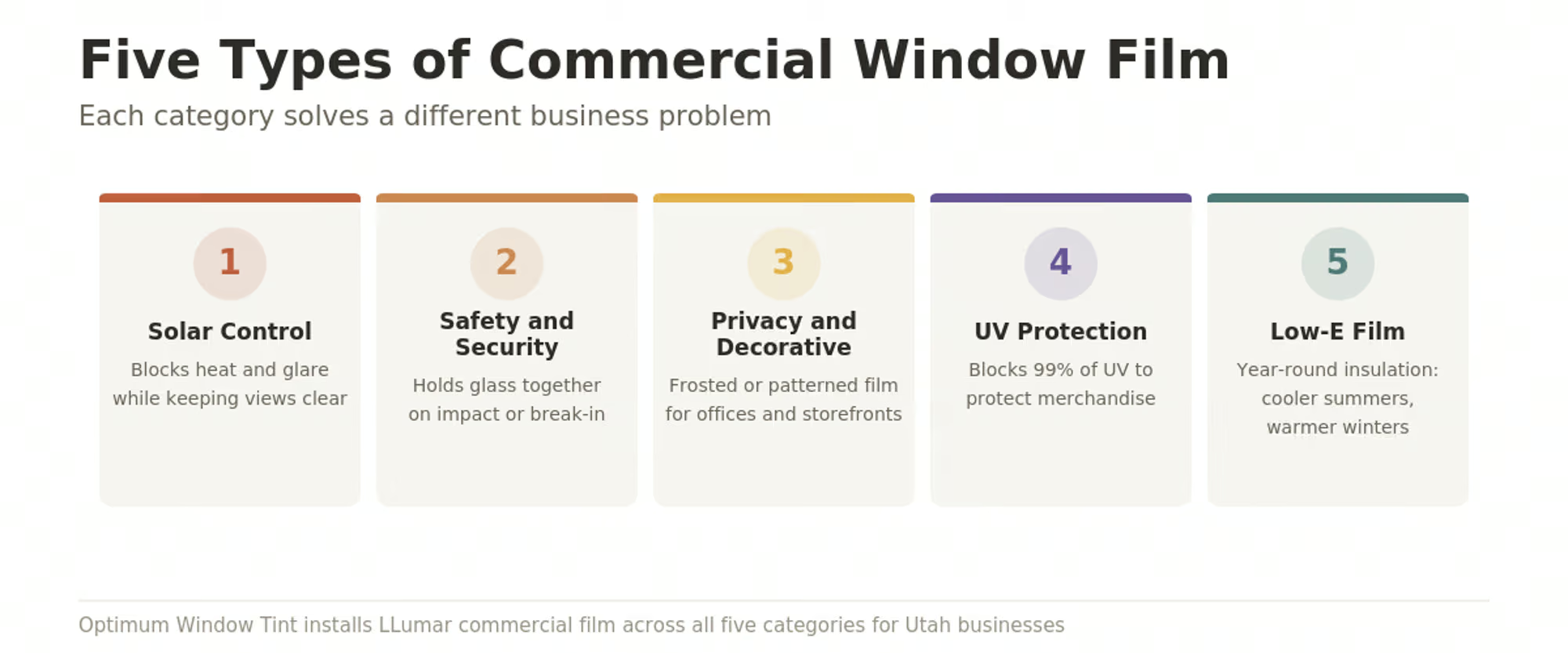
Solar control film is the workhorse of most commercial projects. It blocks heat and glare while maintaining views and natural light, which matters for storefronts that want visible merchandise, offices with mountain views, and any space where darkening the room isn't an option. This is where LLumar's spectrally selective technology earns its keep at commercial scale, rejecting a high percentage of infrared and UV while keeping the visible light levels that make a space feel open and professional. More about commercial solar films.
Safety and security film is the category most business owners don't think about until they need it. Heavy-duty polyester film holds glass together on impact, whether from an accident, a weather event, or a smash-and-grab attempt. It doesn't make glass unbreakable, but it significantly delays forced entry and dramatically reduces injury risk from flying shards. Retail storefronts, restaurants with street-facing glass, and any business that handles valuable inventory should have this conversation. More about commercial safety and security films.
Privacy and decorative film solves an interior design problem without construction. Frosted or patterned film on glass partitions, conference room walls, and storefront windows creates privacy zones, reduces distraction, and gives a space a clean, finished look without the cost or permanence of etched glass. It's particularly useful for office buildouts where the layout changes over time. More about commercial privacy and decorative films.
UV protection film matters most for any business where merchandise, displays, or interior finishes are sitting in direct sun. UV exposure causes approximately 40% of interior fading, and for a retailer displaying apparel, furniture, or art near windows, the cost of that fading adds up faster than the cost of the film preventing it. UV film protects the investment in your interior without changing how the space looks.
Low-E film works year-round, adding an insulating layer to existing glass that reduces heat gain in summer and heat loss in winter. For Utah businesses paying both cooling and heating bills across a long seasonal range, Low-E film delivers returns in both directions. It's particularly effective on older commercial buildings with single-pane or early double-pane glass that was never designed for energy efficiency. More about commercial Low-E films.
What the Financial Return Actually Looks Like
Here's where commercial window film separates itself from most building upgrades.

The U.S. Department of Energy identifies window film as a first-tier energy conservation technology for buildings, with an approximate three-year payback, making it one of the fastest-returning building envelope upgrades available. At commercial scale, the numbers often come in faster than that. Savings of $1 to $2 per square foot of film installed per year, or as much as 19 kWh per square foot of glass, are documented across commercial installations.
To put that in real terms: a commercial building with 3,000 square feet of glass on south and west exposures might see annual energy savings of $3,000 to $6,000 after installation. If that installation costs $24,000 to $42,000 at typical commercial rates, the payback period lands somewhere between 4 and 8 years on energy savings alone, often accelerated by the secondary benefit of reduced HVAC wear and extended equipment lifespan.
Buildings with high glass-to-wall ratios, older glazing, and heavy south and west exposure tend to see the fastest returns. If your building checks those boxes, it's worth getting actual numbers from a professional energy assessment rather than estimating from industry averages.
A few factors that affect where your project lands on that range:
- Glass area and orientation: More south- and west-facing glass means more solar load and more savings potential
- Current glass type: Single-pane and older double-pane buildings have more room for improvement than modern Low-E curtain wall
- Building occupancy hours: A business running air conditioning 10 to 12 hours a day five days a week sees proportionally larger savings than one running shorter hours
- Film specification: High-performance ceramic and spectrally selective films deliver better energy returns than entry-level solar films, which affects both the upfront cost and the payback calculation
Who Benefits Most: Storefronts, Offices, and Everything Between
The benefits of commercial window film aren't uniform across building types. Here's how they tend to distribute across the most common commercial situations along the Wasatch Front.
Retail storefronts have a dual problem: they want maximum visibility for merchandise and foot traffic, but large south- or west-facing storefront glass can make the interior unbearably hot and fade displayed products within months. Spectrally selective solar film solves both sides, keeping the space bright and visible while protecting merchandise from UV damage. Security film on storefront glass is also worth considering for any retail location dealing with high-traffic or vulnerability to forced entry.
Office buildings feel window film's impact most directly in employee comfort and productivity. Hot spots near windows, glare on monitors, and uneven temperatures across open floor plans are consistent complaints that window film addresses at the source. Glare reduction directly improves working conditions for employees using computers near windows, and eliminating hot spots creates more consistent indoor environments that reduce temperature-related distractions. Privacy film on conference room glass is also a common add-on for offices that want functional separation without permanent construction.
Restaurants and hospitality businesses have a specific challenge: the sunniest tables are often the most desirable until they're not. West-facing patio glass or dining room windows that cook guests in the late afternoon create a real customer experience problem. Solar control film brings those spaces back into use during peak hours without blocking the view that made them attractive in the first place.
Warehouses and industrial spaces often overlook window film because they assume their modest window area doesn't justify the investment. But large skylights, loading dock windows, and clerestory glass in distribution or manufacturing spaces can generate significant heat loads that affect worker comfort and add substantially to cooling costs. These are often excellent candidates for film at a lower per-project cost than a multi-story office building.
What to Expect From a Commercial Installation
Commercial window film installations differ from residential in a few meaningful ways, and knowing what to expect makes the process easier to plan around.
Assessment and film selection come first. Before any film is specified, a professional installer needs to walk the building, identify glass types, window shape, window size and quantity, note existing coatings, evaluate orientation, and understand the priorities for each zone of the building. The film that makes sense for a west-facing conference room may be different from the right choice for a north-facing lobby or a south-facing retail display window.
Installation is done with minimal disruption. Most commercial installations are completed in phases, with areas prioritized by solar impact and operational schedule. A professional crew can typically work around business hours for most of the project, and individual rooms or zones are usually back in full use within hours of installation. There's no demolition, no replacement of existing glass, and no extended downtime.
The cure period is the same as residential. Plan to wait 30 days before cleaning newly filmed windows, and brief any cleaning staff who service the building on appropriate products: soft cloth or squeegee, standard glass cleaner, no ammonia-heavy or abrasive products. cure period may differ depending on the film. Your installer will walk you through everything after installation.
LLumar's commercial warranty covers the film for the life of your ownership. The same lifetime warranty that applies to residential installations extends to commercial LLumar film, which means a business owner isn't making a short-term bet on a product that needs to be replaced in a few years. Window film will last the lifetime of the window if installed by a professional.
Getting a Commercial Quote From Optimum Window Tint
Optimum Window Tint serves commercial clients throughout Utah County and the broader Wasatch Front, including American Fork, Lehi, Provo, Orem, Salt Lake City, and surrounding areas. Our team has more than 10 years of installation experience across all five film categories and uses LLumar's professional film-to-glass compatibility system on every commercial project, the same tool that prevents thermal stress issues and ensures the right film goes on the right glass every time. Window film installed professionally will last the lifetime of the window and the lifetime warranty will not be voided if done correctly.
A commercial consultation starts with a site visit. The variables that determine the right film recommendation, glass type, orientation, existing coatings, building use, and aesthetic goals, can't be assessed from a conversation alone. Getting an actual assessment is the only way to produce a quote that reflects what your building needs and what the realistic return looks like.
Ready to find out what window film would do for your Utah business? Contact Optimum Window Tint to schedule a free commercial consultation with our experienced installation team.
Sources
- U.S. Department of Energy / 3M. "Window Film Energy Savings for Commercial Buildings." https://www.3m.com/3M/en_US/building-window-solutions-us/solutions/energy/
- Window Film Depot. "Commercial Window Tinting Services: Complete Guide for Businesses." https://www.windowfilmdepot.com/blog/commercial-window-tinting-services-guide-for-businesses/
- Window Film Depot. "Payback Studies." https://www.windowfilmdepot.com/services/payback-studies/
- American Window Film. "What is the ROI of Installing Solar Control Film in an Office Building?" https://americanwindowfilm.com/blog/solar-control-film-roi-office-buildings
- American Window Film. "Commercial Window Film ROI." https://americanwindowfilm.com/blog/commercial-window-film-roi
- Custom Tint Solutions. "Commercial Window Tinting in Salt Lake City." https://www.customtintsolutions.com/cities-we-serve/salt-lake-city/commercial-window-tinting-salt-lake-city-cut-heat-glare/
- SolarGuard Window Tint. "Commercial Window Tinting." https://801tint.com/commercial/
- EcoArc Films. "Energy-Saving Window Films: Your Savings Calculation Guide." https://www.ecoarcfilms.com/energy-saving-window-films-measuring-cost-benefits
- Global Hi-Tech Films. "Commercial Window Films: Reduce Energy Costs and Boost Efficiency." https://globalhitechfilms.com/blog/commercial-window-films-energy-saving-guide
- Scottish Window Tinting. "Window Film Salt Lake City." https://scottishwindowtinting.com/regions-we-serve/utah/salt-lake-city/