
Does Window Tinting Increase Home Value? What Buyers and Appraisers Say

Every home improvement eventually gets judged by the same question: will this help when I sell? Kitchen remodels, new flooring, fresh paint, they all get weighed against what a future buyer might pay. Window film deserves the same honest look, and the answer is more interesting than a simple yes or no.
So let's be straight from the start. Professional window tinting is unlikely to show up as a single line item on an appraisal that adds a fixed dollar figure to your home. That is not how appraisals work for most upgrades. What window film does instead is quieter and, in a competitive market, often more powerful. It improves the things buyers actually respond to and touches the one factor appraisers genuinely weigh: energy efficiency. This guide breaks down what buyers say, what appraisers consider, and how to make sure your window film helps your sale instead of sitting unnoticed.
The Honest Answer: Perception First, Appraisal Second
Here is the distinction that matters, and that most articles skip right past. There is a difference between a home's appraised value and what a buyer is willing to pay for it. Window film works mostly on the second one.
Appraisers work largely from comparable sales, square footage, condition, and measurable systems. Aftermarket upgrades like window film rarely get their own dollar line, which is exactly why you should be skeptical of anyone promising a guaranteed appraisal bump from tint. What film reliably does is shape buyer perception. It makes a home feel newer, cooler, more comfortable, and better maintained, and that perception is what drives strong offers and faster sales.
Think of it the way real estate agents think about fresh paint, professional landscaping, or new light fixtures. None of those are guaranteed appraisal line items either. They sell the home. They shape the walk-through, the first impression, and the feeling a buyer carries into their offer. Quality window film belongs in that same category of smart, perception-driving upgrades, with one advantage the others don't have: it also lowers the bills.
Where Window Film Actually Moves the Needle
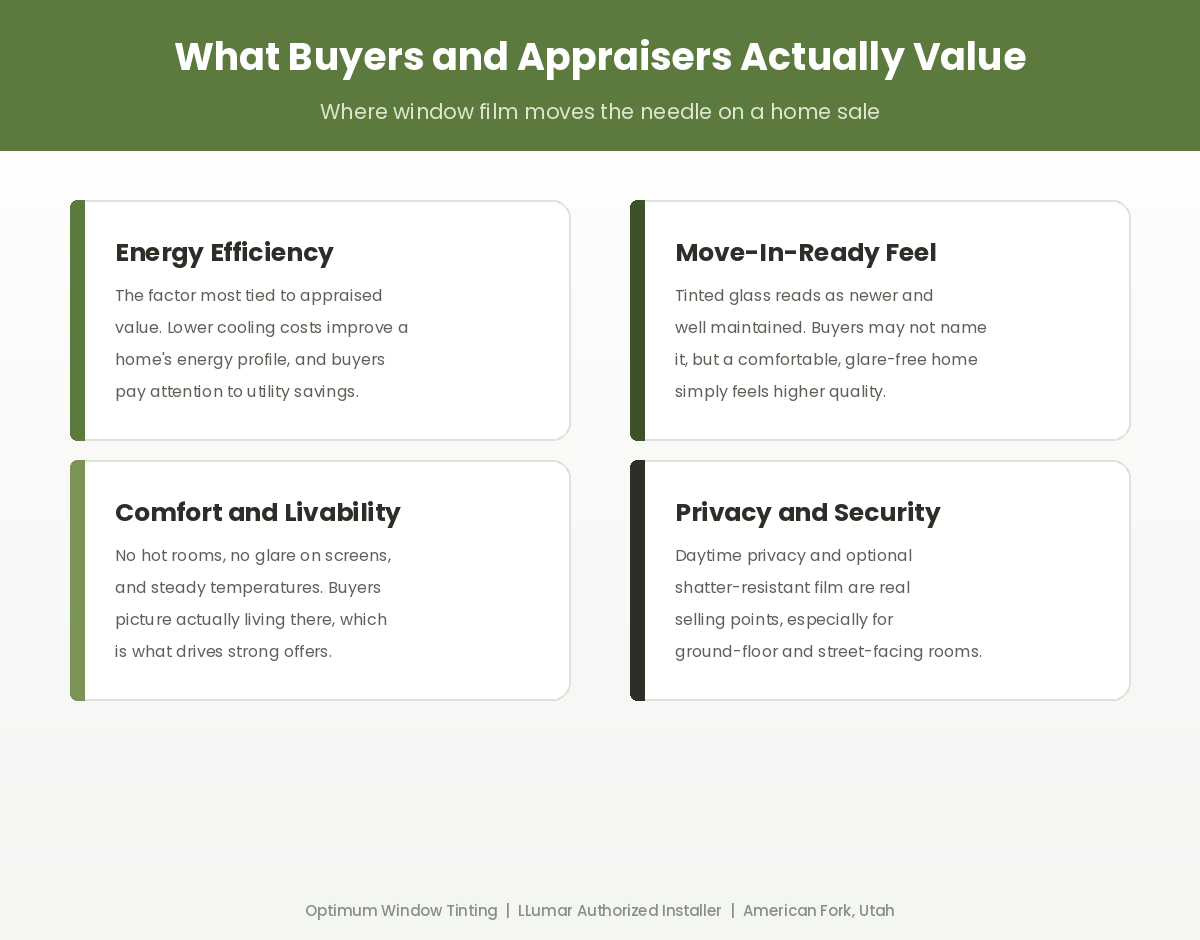
When you look at what buyers respond to and what appraisers measure, the value of window film concentrates in four areas.
Energy efficiency: the one appraisers care about
This is the factor with the clearest link to value. A large share of a home's heating and cooling energy moves straight through its windows, and quality film cuts the heat gain that drives up summer cooling bills. That improved energy profile is the part of window film most likely to influence both buyer decisions and appraised value, because energy performance is something the market increasingly prices in. In a place like Utah, where summer sun is relentless and air conditioning runs hard, lower and more stable cooling costs are a benefit buyers understand immediately.
Energy-efficient features have moved from nice-to-have to expected. Agents now routinely mention window film in the same breath as smart thermostats and solar readiness, because buyers are actively shopping for homes that cost less to run.
Energy savings from window film <
The move-in-ready feel
Buyers form impressions fast, and much of that impression is a feeling they can't quite name. A home with clean, professionally tinted glass simply reads as newer and better cared for. The rooms are comfortable, the glare is gone, and everything feels dialed in. Buyers may not point at the windows and say "it's the film," but that overall sense of a well-maintained, move-in-ready home is precisely what makes them comfortable paying full price.
The reverse is also true and worth knowing. Old, bubbling, or purple-faded film reads as neglect and works against you. If your home already has aging film, replacing it with clean, warrantied film is one of the higher-impact things you can do before listing.
Comfort and livability
This is where buyers actually picture their life in the home. No rooms that are too hot to use in the afternoon, no harsh glare washing out the TV or a home office screen, and steady temperatures from room to room. When a buyer can imagine comfortably living in a space, they make stronger offers. Comfort is hard to quantify on a spec sheet, but it is doing quiet work during every showing.
Privacy and security
Window film gives daytime privacy without sacrificing natural light, which matters most for ground-floor rooms, street-facing windows, and homes with close neighbors. Security films go further, holding shattered glass together to slow down break-ins and reduce storm damage. For a lot of buyers, especially families, that combination of privacy and added safety is a genuine selling point rather than an afterthought.
Why Window Film Punches Above Its Cost
Part of what makes window film a smart resale play is the ratio between what it costs and how broadly it pays off. Set it next to the big-ticket improvements people usually consider, and the comparison is striking.
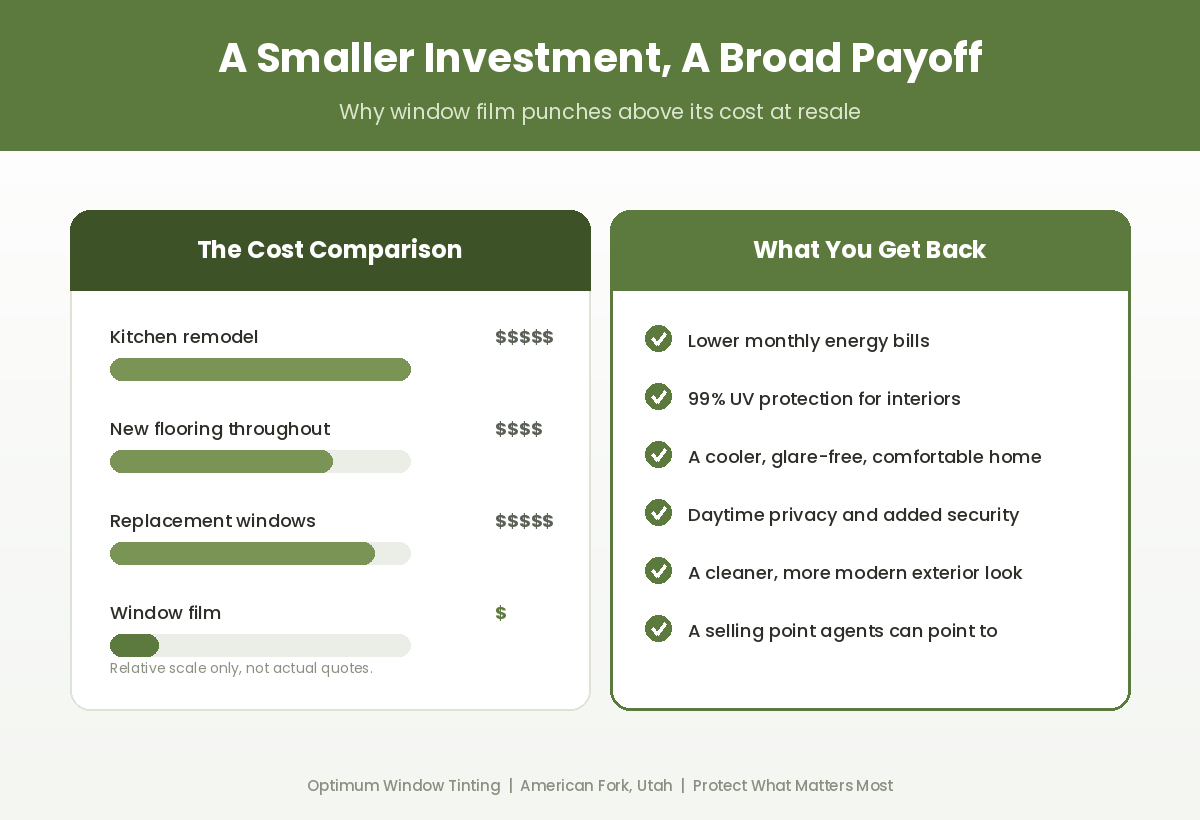
A kitchen remodel, new flooring throughout, or full window replacement are all major investments. Window film is a fraction of any of them, yet it touches an unusually wide set of the things buyers care about: monthly energy costs, UV protection for the interior, everyday comfort, privacy, security, and the exterior look of the home. Few upgrades that modest reach across that many selling points at once.
It also protects the investments already inside the home. UV rays fade hardwood floors, carpet, furniture, and artwork over years of exposure, and quality film blocks up to 99 percent of them. That preservation shows up as a home whose interior still looks fresh, which is exactly the well-kept impression that supports your asking price. In a sense, the film pays you back twice: once in lower bills while you live there, and again in the condition of the home when you sell.
None of this requires a permanent alteration to the house. Film is applied to existing glass and can be updated to suit a buyer's taste if needed, so you get the upside without locking the next owner into a irreversible change.
How to Make Sure Your Tint Helps the Sale
The value of window film is not automatic. A few things separate film that helps your sale from film that does nothing or even hurts it.
Professional installation is the dividing line. Clean, bubble-free film from a certified installer reads as a quality upgrade. DIY or bargain film that bubbles, peels, or discolors reads as a problem the buyer will have to fix, and it drags down the very impression you are trying to build. This is the single biggest factor in whether tint is an asset or a liability at resale.
A manufacturer-backed warranty adds real weight, especially one that transfers to the next owner. Being able to hand a buyer documentation for warrantied, professionally installed film turns a nice feature into verifiable proof that the home has been well maintained. Keep your paperwork, receipts, and warranty details together so you can present them during the sale.
Matching the film to your glass matters too. Modern dual-pane and low-emissivity windows need compatible film to protect the seal and keep the glass warranty intact. A qualified installer handles this as a matter of course, which is another reason professional installation protects your home's value rather than risking it.
Finally, choose film that fits your goals and your climate. In Utah's high-sun environment, quality solar or ceramic film that meaningfully cuts heat gives you the strongest combination of daily benefit and resale appeal. If you want the full breakdown of how projects are priced, check the breakdown here:
The Bottom Line
Will window tinting increase your home's value? The honest answer is that it works differently than a kitchen remodel, and that difference is often in your favor. It is unlikely to add a fixed dollar figure to an appraisal, but it improves the energy efficiency appraisers do weigh, and it strengthens nearly everything a buyer responds to: comfort, a move-in-ready feel, privacy, security, and a clean modern look, all for a fraction of what bigger upgrades cost.
Add in the money it saves you every month you still live there and the interior it protects from fading, and window film stands out as one of the more sensible, low-risk improvements a homeowner can make. The key is doing it right: quality film, professional installation, a transferable warranty, and paperwork you can show. Done that way, window tinting is not just a comfort upgrade. It is a quiet advantage the day you decide to sell.
Thinking about tinting before you list, or just want a more comfortable home in the meantime? Get a free quote from Optimum Window Tinting and find out what professional window film would do for your home.